Summary The House approved the bill clause by clause, while amendments proposed by Aliya Kamran, Naeema Kishwar and Shahida Akhtar Ali were rejected.
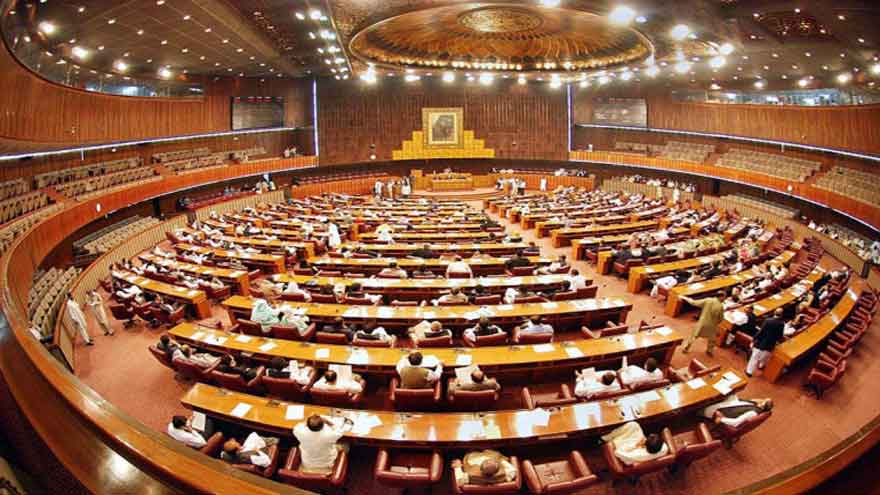
ISLAMABAD (Dunya News) – Pakistan’s National Assembly on Monday passed the Finance Bill 2026-27 by a majority vote, rejecting all amendments moved by the opposition during a session chaired by Speaker Sardar Ayaz Sadiq.
The House approved the bill clause by clause, while amendments proposed by Aliya Kamran, Naeema Kishwar and Shahida Akhtar Ali were rejected. Lawmaker Ali Qasim Gilani withdrew his amendment before voting.
Among the key changes, lawmakers removed Clause 3 relating to the Petroleum Levy and Climate Support Levy. The Assembly also approved an amendment to the Customs Act granting affected parties the right to present their position before any confiscation of assets.
The House endorsed amendments allowing chartered accountants to serve as non-voting members in customs and tax cases, and approved a new sales tax collection mechanism for the steel sector based on electricity consumption per unit.
Several tax relief measures were also approved, including incentives for digitally integrated and POS-linked footwear businesses, extension of sales tax exemptions on aircraft and spare parts imports to airlines other than Pakistan International Airlines (PIA), and implementation of certain exemptions from July 1, 2027.
The Assembly approved amendments allowing taxes on imported mobile phones to be paid in instalments, permitting businesses with an annual turnover of up to Rs200 million to opt out of the final tax regime, and recognising business losses caused by economic difficulties in determining economic viability.
Lawmakers also authorised the State Bank of Pakistan to establish a central virtual repository of banking data, approved a significant increase in surcharges on non-filers, and imposed a five percent withholding tax on income earned through social media platforms.
Additional amendments granted tax concessions to private equity and venture capital funds under specific conditions, reduced the minimum tax rate to 0.5 percent for distributors in the pharmaceutical, fertiliser, sugar and electronics sectors, and exempted exporters with more than 80 percent of total turnover from the application of Super Tax Clause C-4.
The House further approved making taxes deducted from social media payments to non-residents adjustable, requiring proof of deliberate intent in violations under the Federal Excise Act, and allowing chartered accountants to be included in tax dispute resolution committees when necessary.
Other approved amendments gave registered taxpayers the right to object to a nominated auditor within 15 days, maintained a zero federal excise duty on imported electric vehicles valued at up to $75,000, imposed a 30 percent duty on EVs priced between $75,000 and $110,000, and set a 40 percent duty on EVs worth more than $110,000.
The bill also introduced incentives for industries linked to the digital invoicing system, fixed federal excise duty at 86 percent on imported vehicles with engine capacities between 2,000cc and 3,000cc, and at 92 percent on imported vehicles exceeding 3,000cc.
Finance Minister Muhammad Aurangzeb presented the Finance Bill, which was subsequently approved by the House through a majority vote. Following the passage of the bill, the National Assembly session was adjourned until 11am on Tuesday.