Summary World Bank reports 3.7% economic growth in Pakistan for FY2025-26, while inflation averaged 7.1%. Growth is projected at 3.8% and inflation at 8.2% for FY2026-27.
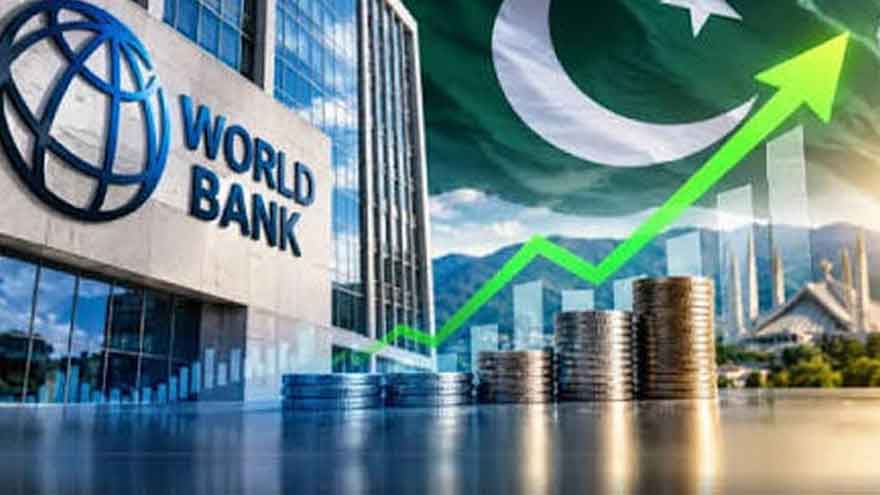
NEW YORK (Dunya News) – The World Bank has released its 2026 economic report on Pakistan’s development outlook, reporting that the country’s economy grew by 3.7 per cent in fiscal year 2025-26, while inflationary pressures intensified amid rising energy prices.
According to the World Bank, international credit rating agencies S&P and Moody’s upgraded Pakistan’s credit ratings. Pakistan also issued Eurobonds worth $750 million and $3 billion in the international market.
The report stated that the agriculture sector recorded growth of 2.9 per cent, with livestock playing a significant role, while the services sector expanded by 4.1 per cent. Pakistan’s foreign exchange reserves reached $19.7 billion, while the overall fiscal deficit declined to 2.6 per cent of gross domestic product (GDP).
According to the World Bank, average headline inflation stood at 7.1 per cent in fiscal year 2025-26, while the State Bank of Pakistan raised its policy interest rate to 11.5 per cent.
Economic growth is expected to reach 3.8 per cent in fiscal year 2026-27, while inflation is projected to rise to 8.2 per cent during the current fiscal year.
IMF raises Pakistan's inflation forecast to 9.9% for FY27
The report noted that average inflation increased from 4.5 per cent in fiscal year 2024-25 to 7.1 per cent in the following fiscal year. Rising energy prices amid the Middle East conflict intensified inflationary pressures.
According to the World Bank, average inflation stood at 10.2 per cent between March and June 2026, reaching a peak of 11.7 per cent in May 2026.
During fiscal year 2025-26, average food inflation in urban areas was recorded at 4.3 per cent, compared with 5.4 per cent in rural areas. Higher prices of wheat and perishable food items contributed to the increase in food inflation.
The report stated that food items remained the largest contributors to inflation in both urban and rural areas through August 2026.
It further reported that between February and June 2026, petrol prices increased by approximately 36 per cent, high-speed diesel prices rose by 31 per cent, and liquefied petroleum gas (LPG) prices climbed by around 46 per cent. Transport fares also increased by approximately 30 per cent during the same period.
According to the World Bank, rising energy prices since March 2026 further intensified inflationary pressures. During fiscal year 2025-26, average core inflation stood at 7.4 per cent in urban areas and 8.5 per cent in rural areas, while urban core inflation reached 9 per cent in May 2026.