Summary Pakistan warns that the UN liquidity crisis is undermining peacekeeping operations, reducing patrols and security. Ambassador Asim calls for predictable funding and reforms to address evolving threats
NEW YORK (Dunya News) – Pakistan has warned that the United Nations liquidity crisis is directly undermining peacekeeping operations by reducing patrols, mobility and field presence, with serious consequences for mandate delivery, protection of civilians, deterrence against violence and the safety and security of peacekeepers.
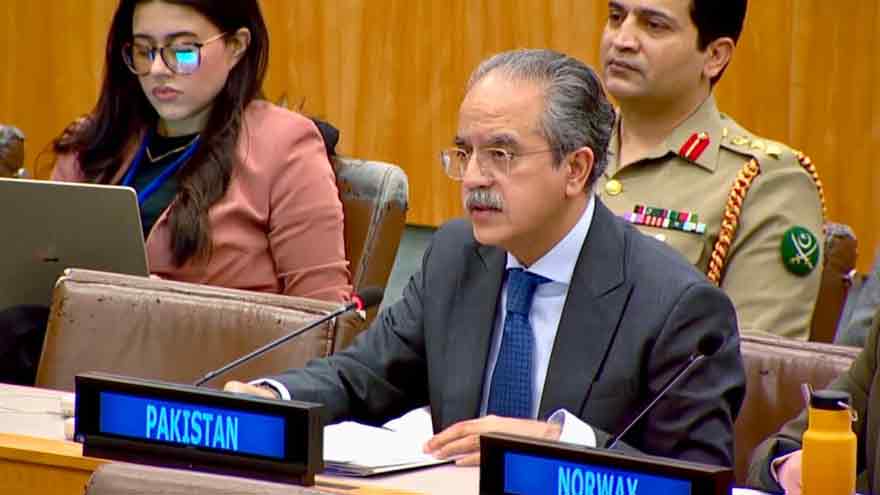
Speaking at the opening of the Special Committee on Peacekeeping Operations (C34), Ambassador Asim Iftikhar Ahmad, Permanent Representative of Pakistan to the UN, said UN peacekeeping remains an indispensable instrument for maintaining international peace and security, adding that it is facing mounting political, operational and financial pressures that require collective reflection and action.
Recalling Pakistan's long-standing contribution to peacekeeping, the ambassador said that Pakistan hosts one of the oldest peacekeeping missions, the United Nations Military Observer Group in India and Pakistan (UNMOGIP). He noted that Pakistan has been among the largest and longest serving troop contributors for over six decades, with over 250,000 Pakistani peacekeepers having served in 48 missions across the four continents. He paid rich tribute to 182 Pakistani peacekeeping personnel, who have made the ultimate sacrifice under the UN flag.
Ambassador Asim noted that while several missions have transitioned or drawn down in recent years, no new UN peacekeeping mission has been established for over a decade, despite rising global instability and the highest levels of conflict since the Second World War. He said the recent resort to non-UN and ad-hoc missions reflects a continuing demand for peacekeeping, and added that the central challenge is not relevance, but resolve and collective political will.
Outlining the comparative advantages of UN peacekeeping, he stated that its legitimacy is derived from universal participation, assessed predictable financing, and established mechanisms, including command and control structures, logistics, and accountability frameworks. He warned that predictable financing, once core strength, has become the biggest challenge, with contingency planning measures now reducing troops and civilian staff across the missions.
Calling for mandates authorized by the Security Council to be matched by commensurate and predictable resources, the Pakistan UN Ambassador urged a serious and structured review of the financial architecture underpinning UN peacekeeping to ensure that funding is predictable, sustainable and aligned with mandates.
He cautioned that if financial commitments wane and missions continue to contract without clear strategic direction, the readiness of troop contributing countries to maintain forces earmarked for UN deployment could also be affected, including standby arrangements, rapid deployment capabilities and specialized units.
Describing reform as necessary, the permanent representative said that peacekeeping must become more agile, focused and better equipped to address evolving threats, including through technology and stronger partnerships. He said protection of civilians, deterrence against violations, and ceasefire monitoring and verification remain foundational tasks, and that lack of political progress should not be used as a pretext for withdrawing missions.