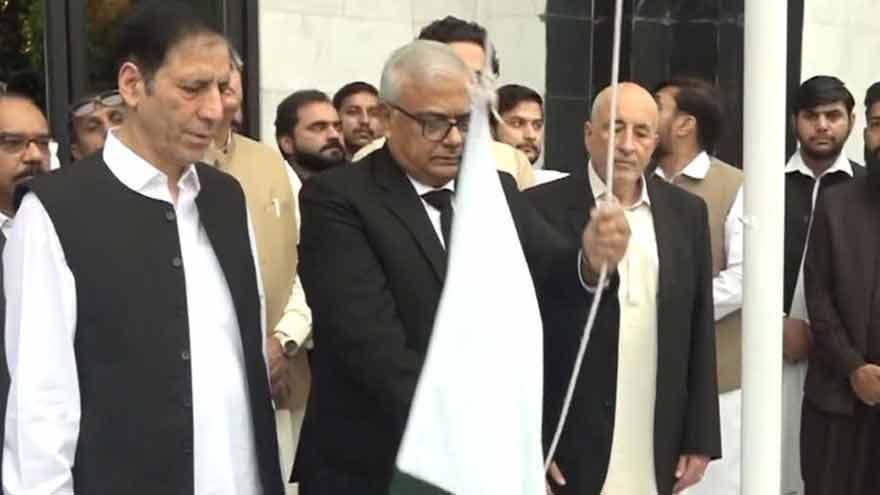
Summary Pakistan’s 79th Independence Day was marked by flag-hoisting ceremonies at superior courts, where chief justices highlighted sacrifices, unity, justice and national development.
LAHORE (Dunya News) – Flag-hoisting ceremonies were held at the Federal Constitutional Court, four high courts and the Supreme Court of Azad Jammu and Kashmir on Pakistan’s 79th Independence Day, with chief justices highlighting sacrifices for the country, the importance of unity and the role of justice in national development.
Federal Constitutional Court
Chief Justice of the Federal Constitutional Court Justice Aminuddin hoisted the national flag, while prayers were offered for the safety and security of the country and nation.
Addressing the ceremony, Justice Aminuddin said Pakistan was the result of immense sacrifices and that the sacrifices of the country’s forefathers must be passed on to future generations. He said Pakistan possessed abundant resources and an effective system.
Lahore High Court
Chief Justice of the Lahore High Court Justice Aalia Neelum hoisted the national flag at the historic building of the Lahore High Court.
Justice Aalia Neelum said that by the special grace of Allah, the nation was celebrating its 79th Independence Day. She said love for the homeland was part of faith and it was the nation’s duty to work day and night for the country’s glory.
She said the judiciary in Punjab was striving to ensure the best possible delivery of justice. She said clearing the backlog of cases had been a major challenge a few years ago, but the Lahore High Court made history by deciding more than 173,000 cases in 2025.
She added that more than eight million cases had been decided by Punjab’s district judiciary over the past two years. She said deciding such a large number of cases was not easy and judges had worked day and night for the country and nation.
Sindh High Court
Chief Justice of the Sindh High Court Zafar Ahmed Rajput hoisted the national flag, while other judges of the high court and a large number of lawyers attended the ceremony.
Chief Justice Zafar Ahmed Rajput said Independence Day was an occasion to remember the sacrifices and struggle of the founder of Pakistan and the leaders and workers of the Pakistan Movement. He said freedom fighters such as Rooplo Kolhi and Soorih Badshah sacrificed their lives while fighting against colonialism.
He said the nation would remain indebted to the martyrs forever. He said Independence Day reaffirmed the commitment to work for the country’s development with faith, unity and discipline and taught people to remain united beyond differences of color, race and language.
He said lawyers had a central role in a strong society, as they were guarantors of the rule of law and citizens’ rights. He added that an independent and fair judiciary played an important role in building a strong and developed society.
The Sindh High Court chief justice said an independent judiciary ensured the rule of law in society. He said timely and affordable justice helped eliminate unrest, while impartial decisions provided the foundation for national and social stability.
Supreme Court of Azad Kashmir
In Muzaffarabad, Chief Justice of the Supreme Court of Azad Jammu and Kashmir Justice Raja Saeed Akram hoisted the national flag. Judges of the Supreme Court and High Court attended the ceremony, while schoolchildren also performed national songs.
Justice Raja Saeed Akram said Pakistan was a strong nuclear defence power. He said Pakistan had provided much to Azad Kashmir compared with occupied Kashmir, adding that whatever freedom existed in Azad Kashmir was because of Pakistan.
He said an Indian lieutenant governor in occupied Kashmir had retained all powers with himself, while Pakistan had provided Azad Kashmir with a Supreme Court, High Court and Legislative Assembly.
Balochistan High Court
Chief Justice of the Balochistan High Court Justice Kamran Khan Malakhail hoisted the national flag and addressed the ceremony, saying Allah had blessed the nation with freedom and that the real strength of nations lay in unity and solidarity.
Justice Kamran Malakhail said people came to courts not simply for justice but to end injustice. He stressed that justice should not be limited to courts and must be ensured in every sphere of life.
He said it was the responsibility of people to deal justly with parents, children, relatives, neighbours and subordinates. He added that if people pledged to live according to justice, many problems could be resolved automatically.
He said if brothers and sisters recognized each other’s rights in property, litigation would decrease. Justice Kamran Malakhail added that if officers treated their subordinates fairly, they would be able to perform their duties better.
He said when people no longer feared injustice, they would perform their responsibilities more effectively. He stressed that the nation must pledge to take practical steps to change its condition.