Summary Interior Minister Mohsin Naqvi defends Governor’s Rule in KP, saying terrorism remains the government’s priority amid failed talks and security concerns.
ISLAMABAD (Dunya News) – Information Minister Attaullah Tarar on Sunday accused the Pakistan Tehreek-e-Insaf (PTI)-led government in Khyber Pakhtunkhwa of having a “nexus” with terrorist groups, as the federal government defended its decision to impose emergency rule in the province, citing the deteriorating security situation.
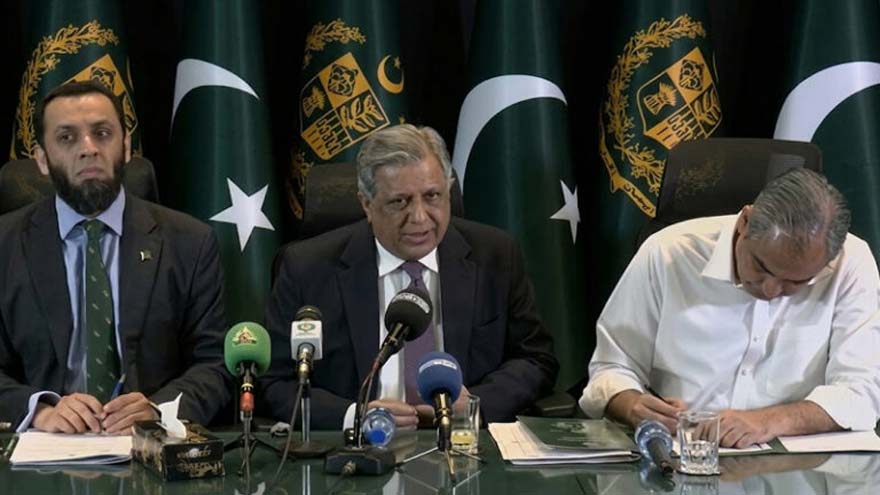
Tarar made the allegations during a press conference in Islamabad alongside Interior Minister Mohsin Naqvi, Law Minister Azam Nazeer Tarar and Minister of State for Interior Tallal Chaudhry. The briefing followed the federal government’s decision to impose emergency rule in KP over what it described as the provincial government’s failure to adequately combat terrorism.
The federal government and the PTI, which governs Khyber Pakhtunkhwa, have been at odds over several issues, particularly counterterrorism policy. The disagreement was among the key factors behind the breakdown of talks between the two sides on October 3.
Addressing reporters, the information minister claimed that all cabinet members who attended Sunday’s meeting believed the PTI-led provincial government was working in coordination with terrorist groups.
“PTI’s government in KP is hand in glove with terrorists and has an unholy alliance with terrorists,” Tarar alleged.
He cited reports from the Intelligence Bureau and law enforcement agencies, claiming that militants had gained influence over the administration of several districts.
According to the minister, while political parties in the region had faced attacks by terrorist groups, the PTI had allegedly been able to move through certain areas with relative security.
“What is the reason that even police stations of some districts have been sublet to the Taliban?” he asked, arguing that the situation went beyond administrative inaction or incompetence and amounted to the alleged empowerment of militants.
The allegations have not been independently verified.
‘Power-sharing formula’ allegedly emerging
Tarar further claimed that a power-sharing arrangement between terrorist groups and the PTI-led provincial government was gradually taking shape, beginning in the southern districts and extending into other parts of Khyber Pakhtunkhwa.
He alleged that the purported arrangement had allowed militants to establish influence over several districts, contributing to attacks on civilians and public infrastructure.
“I say this publicly that these [Taliban] are foreign-funded people who want to bring our country to destruction,” the minister said.
He described what he alleged was the provincial government’s facilitation of such groups as a breakdown of constitutional governance.
Tarar raises questions over police appointments
The information minister also referred to a recent bill concerning police appointments, alleging that the KP government intended to recruit individuals linked to terrorist organisations into the police force.
He claimed that such measures could further undermine security and push the province towards greater instability.
“Evidence of this is available,” Tarar said, maintaining that the provincial government’s alleged actions posed a serious threat to the province’s security.
The federal government has cited the security situation and the need for stronger counterterrorism efforts as reasons for imposing emergency rule in Khyber Pakhtunkhwa.
Naqvi defends KP emergency, says terrorism left govt with no choice
Interior Minister Mohsin Naqvi has said the federal government has no issue with the sit-in, stressing that its only concern is terrorism. He said the condition to postpone the sit-in was proposed by the Pakistan Peoples Party (PPP), adding that the government had never asked protesters to call it off.
Naqvi made these remarks during a press conference in Islamabad alongside Federal Ministers Azam Nazeer Tarar, Attaullah Tarar and other officials.
Law Minister Azam Nazeer Tarar said the president had invoked Articles 232 and 234 of the Constitution to declare an emergency. He added that Interior Minister Mohsin Naqvi would explain the circumstances that led to the decision.
Govt tried for a month to bring KP government on board
Naqvi said the day had been difficult and that the federal government had spent a month trying to bring the Khyber Pakhtunkhwa government on board.
He said he had remained in contact with the provincial government behind the scenes while discussions and meetings concerning the long march were underway.
According to Naqvi, Prime Minister Shehbaz Sharif was scheduled to leave for New York on September 17, and it was decided that he would meet the opposition before departing. A committee was also proposed, with a meeting expected on October 15 or 16, but no response was received.
He said contacts continued despite the lack of a response, adding that a meeting was also held between the president and the prime minister. Naqvi said he had urged the president to bring the KP government on board.
He added that the draft underwent four changes the following day, but when the arrangements appeared to have been finalised, another draft emerged.
‘We never asked them to call off the sit-in’
Naqvi said he remained in contact with Pakistan Tehreek-e-Insaf (PTI) leaders until 11:45pm the previous night.
He said a proposal had been included in one paragraph of the draft, but the PTI leaders did not respond. He added that during his final call at around 11:45pm, he told them that an agreement was still possible, but received no response.
Naqvi also mentioned a meeting between Jamiat Ulema-e-Islam-Fazl (JUI-F) chief Maulana Fazlur Rehman and the prime minister.
“Whenever we spoke to them, we told them that we had no issue with the sit-in; our only concern was terrorism,” Naqvi said.
He maintained that the government had remained in contact with the opposition and had previously taken the initiative to reach out to the PTI.
“The condition to postpone the sit-in came from the PPP. We never asked them to end it. They are welcome to hold a sit-in if they wish; our focus is counterterrorism,” he said.
‘Situation in KP is extremely bad’
The interior minister said the security situation in Khyber Pakhtunkhwa had deteriorated significantly, with residents in some districts unable to venture outdoors after evening.
He referred to the death of an Election Commission official the previous night and said he had held several meetings with Sohail Afridi, during which terrorism was the main topic of discussion.
Naqvi said the federal government had proposed a plan to strengthen police forces in the affected districts. According to him, Afridi had cited a lack of funds as a problem, and Naqvi had assured him that the federal government would provide the necessary financial support.
He further claimed that during negotiations, the provincial side had agreed that emergency measures should be imposed in those districts.
Naqvi said the federal government had struggled to secure public support for its counterterrorism efforts, adding that some officials had been reluctant to be photographed with federal representatives or have such pictures released.
He said he had never asked provincial officials to pose for photographs or publish them.
‘Terrorism cannot be fought alone’
Naqvi said the federal government could not continue losing security personnel to terrorism while the provincial government failed to take ownership of the fight.
“Terrorism cannot be fought alone under any circumstances. It requires a collective effort,” he said.
The interior minister said the difficult decision had been taken against the backdrop of ongoing security challenges and that the government had made every effort to avoid reaching this point.
He claimed that 518 police personnel had been martyred over the past 18 months.
Naqvi said the situation could have been different if the government had received a positive response the previous night. He urged the provincial leadership to explain who had been obstructing efforts to reach an agreement.
He concluded by saying the federal government had been left with no option but to impose Governor’s Rule.