
Summary Satellite data logs 2,306 fires near Lahore in a week, prompting Punjab crackdowns on emissions and crop burning as smog risks rise.
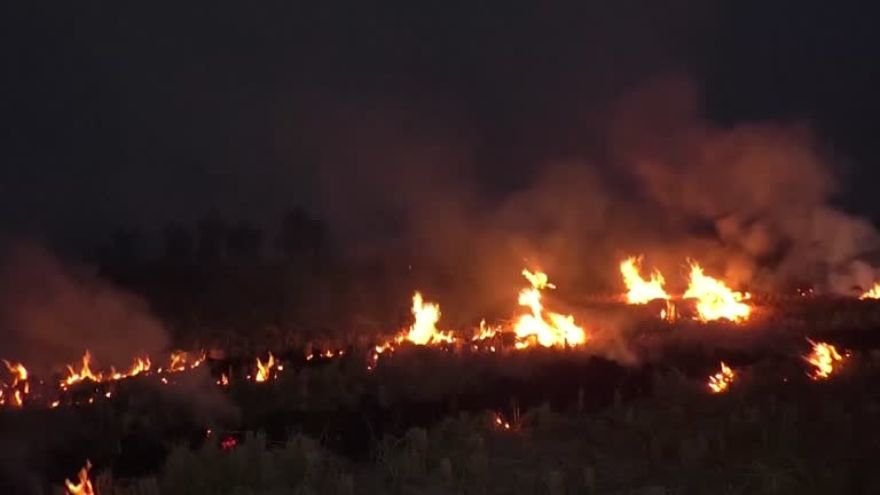
LAHORE (Web Desk) – A total of 2,306 fire incidents were recorded across Pakistan and India within a 300-kilometer radius of Lahore between November 11 and 17, according to new satellite data, raising concerns over further deterioration in the city's air quality.
An analysis by the Pakistan Air Quality Initiative (PAQI), utilising data from Hawanama and NASA satellites, revealed 1,265 fire incidents in Pakistan and 1,043 across the border in India during the seven-day period. During this time, air masses reaching Lahore passed over an average of 17.3 active fire spots in the preceding 72 hours.
Air quality monitoring showed that average fine particulate matter (PM2.5) concentrations in Lahore were 37 micrograms per cubic meter (µg/m³) higher on days when winds blew through areas with heavy fire activity. Tracking 72-hour wind trajectories revealed that on days when incoming air crossed at least 16 fire zones, Lahore recorded an average Air Quality Index (AQI) of 261 and PM2.5 levels of 211.5 µg/m³. On other days, the average AQI stood at 224 with PM2.5 levels at 174.3 µg/m³. PAQI based this comparison on data from five days this year and nine days from the previous year.
Despite the high number of blazes, regional fire activity remained below historical averages. In Pakistan, the count was 18 percent lower than the 2018–2025 average of 1,539 fires for the same week. Meanwhile, fire incidents in India dropped to their lowest level for this timeframe since 2018, falling sharply from an eight-year average of 7,657 incidents.
The report noted a recurring pattern over recent weeks in which spikes in fire incidents are typically followed by a rise in PM2.5 levels roughly three days later. However, meteorological conditions this year offered some relief compared to last year. Average wind speeds between November 11 and 17 reached 4.9 km/h, marking an 81 percent increase over last year’s average of 2.7 km/h during the same period.
Similarly, the afternoon mixing height—the vertical depth of the atmosphere available for pollutants to disperse—averaged 1,190 meters this year, up from 850 meters last year. According to the report, higher mixing heights combined with faster winds help dilute pollution across a larger atmospheric volume.
On the administrative front, Senior Provincial Minister Marriyum Aurangzeb stated that slow-moving northwesterly winds, averaging around five kilometers per hour according to her department's figures, have impacted Lahore's air quality. She emphasized that while weather patterns influence smog levels, strict enforcement operations are underway to curb local sources of pollution.
Over the past 24 hours, the Punjab Environment Protection Department (EPD) inspected 318 industrial units across the province, sealing 11, registering one First Information Report (FIR), and imposing fines totaling Rs. 1.32 million. During the same period, authorities checked 543 brick kilns, demolishing five, sealing 13, filing nine cases, and levying Rs. 2.2 million in fines.
In crackdowns against substandard plastic, teams inspected 159 locations, seizing 740 kilograms of plastic, sealing three premises, and issuing Rs. 55,000 in fines. Officials also checked 93 barbecue and commercial cooking outlets, finding suction hoods installed at 52; one violating outlet was sealed and fined Rs. 72,000. Additionally, 17 sites were inspected to control fugitive dust, resulting in six notices, one sealed site, and the installation of sprinklers at two locations.
Regarding agricultural emissions, EPD figures indicate 420 confirmed cases of crop residue burning across Punjab so far this season, leading to 237 FIRs and prosecutions alongside Rs. 3.255 million in fines. Between November 15 and 17 alone, 18 stubble-burning incidents were reported, resulting in 15 FIRs and Rs. 60,000 in penalties.
To promote alternatives to burning crop waste, the Agriculture Department reported that 96.2 percent of Punjab's rice harvest is complete, covering 6.089 million acres out of 6.332 million acres. According to official statistics, 187 balers have collected crop residue across 164,442 acres, 1,259 Kubota harvesters completed harvesting on 734,143 acres, and 10,045 super seeders were deployed to sow wheat across 2.037 million acres without burning stubble.
Meanwhile, an awareness campaign on emission testing and certification for private vehicles was conducted in Lahore in collaboration with the EPD. Vehicle owners were briefed on testing requirements and certification procedures, while informational brochures detailing Punjab Vehicle Inspection and Certification System (PVICS) testing centers were distributed.