


Govt not against solar energy but wants fair policy for all: minister
Business
A balanced dispatch strategy is being practiced where coal provides base generation and gas supports flexibility

ISLAMABAD (APP) - Federal Minister for Power Sardar Awais Ahmed Khan Leghari on Saturday said the notion that the government is against solarisation is completely false and it fully supports solarisation but in a manner that is JUST to all consumers and doesn’t unfairly burden non solar consumers.
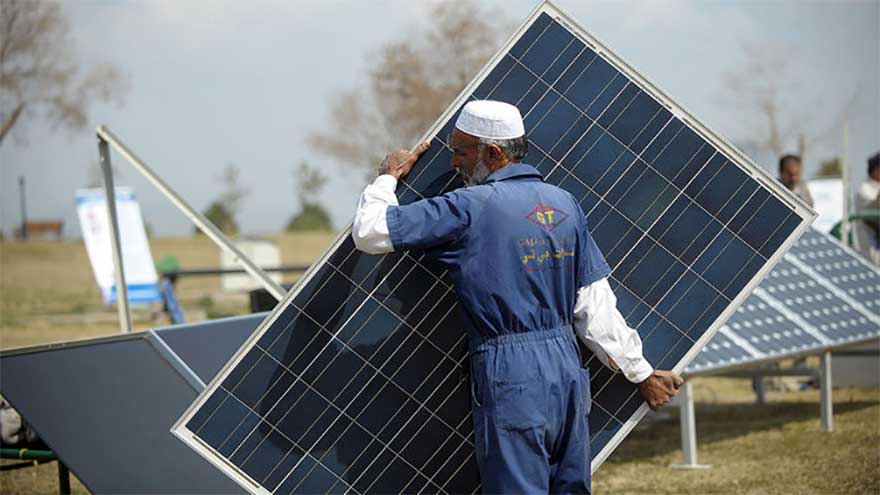
In a statement issued here, he said though, solar power makes up for fossil fuel generated power, however, that is only during solar hours of the day.
During the night time, stable/dispatchable sources of power generation are mandatory for the power grid to remain stable and cater for the dynamically changing load conditions.
It is a universal truth that high penetration of unmanaged rooftop solar introduces grid stability challenges, including steep evening ramp requirements that actually increase dependence on flexible gas based generation, he said.
He said given the unprecedented LNG supply disruption following force majeure declared by QatarEnergy amid the US–Israel–Iran conflict, some degree of demand management across sectors has become unavoidable.
He said while limited curtailment to the fertiliser sector may occur during such crises, it is typically managed carefully due to its importance for food security.
Similarly, any restrictions on commercial or higher-end domestic consumers would be targeted, temporary, and driven by system exigencies, not policy preference.
The overarching objective in such extraordinary circumstances is to balance supply and demand, protect priority sectors, and maintain system stability without triggering widespread consumer unrest, he said.
Leghari said the suggestion to fully shift to coal-based generation and shut down gas plants does not reflect how the power system is optimally operated.
In practice, indigenous coal plants are already prioritized in the merit order due to their relatively lower fuel cost and are dispatched accordingly.
However, gas-based plants serve a critical role in providing flexibility, particularly during peak demand periods and for managing rapid ramping requirements, such as the transition when solar generation drops at sunset and consumers shift back to the grid, he said.
He said completely sidelining gas plants would compromise system stability and operational responsiveness. Therefore, a balanced dispatch strategy is being practiced where coal provides base generation and gas supports flexibility. This is essential for reliable grid operation, he said.
Leghari said the assertion that higher gas prices for captive power have pushed industry away from the grid is not fully supported by recent trends. In fact, following the imposition of the captive power levy, grid demand has increased significantly, indicating that industrial consumers are largely staying connected to the grid rather than shifting away.
This is further reinforced by the government’s surplus power package, offering electricity at around PKR 23/kWh, which has provided a strong price signal to retain industrial load on the system.
For instance, January 2026 recorded the highest ever demand with a 12.1% year-on-year increase, while February 2026 also saw robust growth of around 11% YoY in energy demand. For the first two months, industrial consumers have collectively realized savings of approximately PKR 12 billion under the surplus power package, he said.
He said this is not a time for point scoring, but rather to recognize that Pakistan is managing the current global energy crisis in a measured, strategic and effective manner.
Thanks to our largely indigenous and diversified power generation mix, the potential impact on electricity supply is significantly mitigated, if not entirely avoided, despite the prolonged US–Israel–Iran conflict affecting LNG deliveries, he said.
Leghari said the government is also vigorously pursuing other reforms including the privatization of state-owned enterprises and the allowance of third-party access to the electricity network under the liberalized market framework, and has already achieved notable progress in several areas.
As far as solarization is concerned, consumers are actively encouraged to install their own solar or other clean energy systems in a fair and “JUST” manner that does not unfairly burden other consumers. The focus of the government remains on ensuring energy security, maintaining system stability and supporting economic continuity in this unprecedented period of global energy uncertainty, he said.
