Summary Iran confirms deaths of air defence personnel in separate Israeli strikes
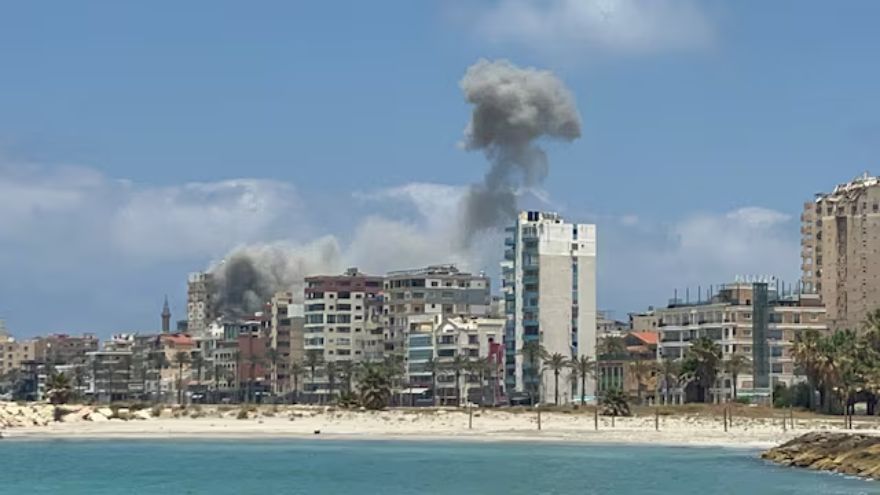
BEIRUT (Agencies) – At least eight people have been killed in an Israeli airstrike on the southern Lebanese city of Tyre in Lebanon, according to the Lebanese health ministry, following an evacuation order issued by the Israeli military covering the entire city for the first time.
The strike, which hit the city’s eastern edge on Tuesday, was described by the ministry and state media as one of the deadliest attacks on Tyre since the current phase of conflict escalated in March. The warning prompted widespread flight from the area, with residents heading north as civil defence teams assisted elderly civilians and those unable to leave independently.
The state-run National News Agency (NNA) reported that “enemy warplanes launched a heavy strike on Tyre”, while eyewitnesses cited by AFP described heavy traffic out of the city and growing panic as evacuation orders circulated. Footage verified by international agencies showed debris scattered across roads, smoke rising from damaged buildings, and rescue crews working through rubble in search of survivors. Emergency teams continued operations into the day as fears grew that more victims could be trapped beneath collapsed structures.
WIDESPREAD DISPLACEMENT
The Israeli military’s evacuation warning extended to all neighbourhoods of Tyre, including areas that had previously been excluded from such orders, such as the northwestern Christian quarter where displaced families had been sheltering. Lebanese state media reported a rapid exodus of civilians following the announcement, with convoys of vehicles moving northwards and civil defence units transporting vulnerable residents into temporary shelters. The strike came shortly after Israeli authorities alleged that militants from Iran-backed Hezbollah were operating in the area, though no supporting evidence was provided publicly.
Doctors Without Borders (MSF) said it was “deeply concerned” by what it described as forced displacement practices, warning that evacuation orders issued ahead of strikes expose civilians to further harm by forcing movement under unsafe and chaotic conditions. The organisation confirmed it had suspended operations at several nearby hospitals and mobile clinics for the day due to security risks.
DAMAGE IN TYRE AND BORDER AREAS
Separate strikes were also reported in the border town of Maroun al-Ras, where NNA said residential homes were destroyed. In Tyre’s al-Bass district, casualties were confirmed following an Israeli air raid, according to local reports cited by international media. The Lebanese health ministry said rescue teams were continuing to search through the wreckage for additional survivors.
The attack marks one of the most severe incidents in Tyre since cross-border hostilities escalated after Israel expanded its military operations in southern Lebanon in response to rocket fire launched by Hezbollah in support of its ally Iran.
Casualties in Iran
The strike on Tyre occurred against the backdrop of broader regional tensions. Iranian state media reported that at least two members of Iran’s army air defence force were killed in Israeli strikes carried out the previous day. The individuals were reportedly engaged in defending Iranian airspace during what Tehran described as “aggression” by Israel.
Although both Israel and Iran have signalled a halt to direct exchanges following diplomatic intervention, including appeals from the United States, tensions remain high. Iranian officials have warned that hostilities could resume if Israeli operations against Hezbollah continue in Lebanon.
In northern Israel, military activity also persisted, with reports of an incident near the Ramim Ridge area close to the Lebanese border, where one person was killed during an exchange of fire, according to Israeli authorities.
The escalation has further strained already fragile humanitarian conditions in southern Lebanon, where repeated evacuation orders have displaced large segments of the population. Aid organisations have warned of growing instability as medical facilities scale back operations and civilians are forced to move repeatedly under threat of airstrikes.
The United States has continued diplomatic efforts aimed at preventing further escalation, though a ceasefire framework announced earlier has struggled to hold. Meanwhile, both Israeli and Iranian officials maintain conflicting positions on the scope of hostilities, particularly regarding Lebanon, where fighting involving Hezbollah remains active.
Oil markets also reacted to the shifting conflict dynamics, with prices easing after reports of a temporary pause in Israeli-Iranian direct strikes, reflecting uncertainty over the durability of any de-escalation.