
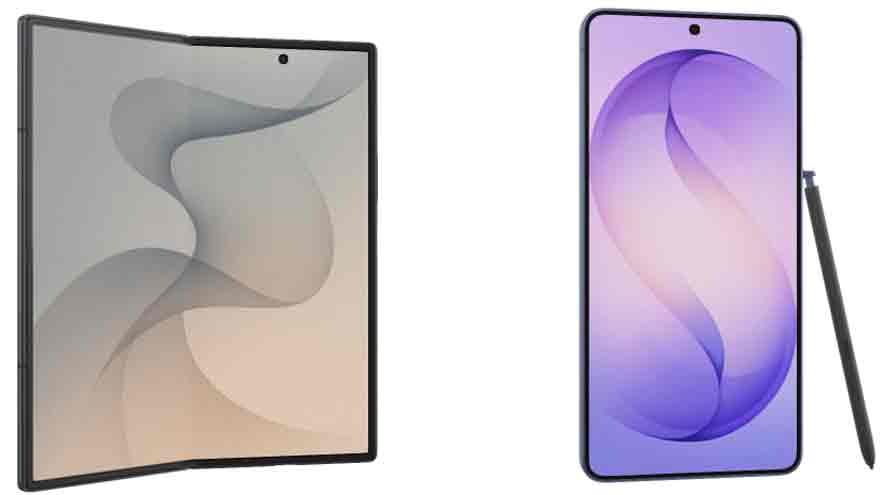
Summary Galaxy Z Fold8 Ultra targets users who want a foldable device with a tablet-sized display, while Galaxy S26 Ultra focuses on durability, battery life and a smartphone experience.
Samsung’s latest flagship phones offer two very different approaches to premium smartphone design. The Galaxy Z Fold8 Ultra targets users who want a foldable device with a tablet-sized display, while the conventional Galaxy S26 Ultra focuses on durability, battery life and a familiar smartphone experience.
Despite their different designs, the two phones have surprisingly similar overall footprints. The Z Fold8 Ultra provides considerably more screen real estate without weighing significantly more than the S26 Ultra. However, the S26 Ultra is taller and wider, with its 6.9-inch 19.5:9 display offering a more comfortable experience for typing and everyday smartphone use.
The Z Fold8 Ultra uses a 6.5-inch cover screen with a tall 21:9 aspect ratio. It works particularly well for social media feeds, articles and cinematic content, but typing can feel cramped. Open the phone and its 8.9-inch, nearly square 11:10 display becomes much more useful for multitasking, productivity and tablet-optimised applications. However, 16:9 video does not make particularly efficient use of the available space.
Durability remains an important difference. Both phones feature premium materials, but the S26 Ultra has an inherent advantage because its display uses rigid glass. The Fold8 Ultra's flexible internal screen remains more vulnerable to damage and can develop a more visible crease over time.
Samsung has strengthened the foldable with its new “Flex Titanium” construction, incorporating additional titanium-alloy elements into the display assembly. The company says the design improves resistance to pressure and impact while reducing crease visibility. Its redesigned hinge is also intended to make opening and closing smoother.
The S26 Ultra nevertheless has the stronger protection rating, with IP68 certification compared with IP48 on the Z Fold8 Ultra. Both offer water resistance, but the S26 Ultra provides significantly better protection against dust.
Display quality is excellent on both devices. All three screens support 120Hz LTPO refresh rates. The S26 Ultra has the higher resolution at 1440 x 3120 pixels, while the Fold8 Ultra’s internal display has been upgraded to match its cover screen at 422 pixels per inch. In everyday use, the difference in sharpness is difficult to notice.
Samsung rates the Fold8 Ultra's displays at up to 3,000 nits, compared with 2,600 nits for the S26 Ultra. Real-world testing, however, puts the three displays much closer together. Both phones also deliver strong HDR performance.
The S26 Ultra has two notable extras: S Pen support and Samsung’s hardware-based Privacy Display.
Battery capacity is identical at 5,000mAh, but the S26 Ultra generally offers better battery endurance, particularly when the Fold8 Ultra's large internal screen is used extensively. Charging is another advantage for the S26 Ultra, which supports 60W wired charging compared with 45W on the Fold8 Ultra, while wireless charging reaches 25W versus 20W.
Ultimately, the choice comes down to priorities: the Z Fold8 Ultra offers dramatically more screen space and greater flexibility, while the S26 Ultra delivers a more conventional design with stronger durability, longer battery endurance and faster charging.