
Summary Researchers recorded 91 bird species across 12 orders and 26 families during autumn surveys.
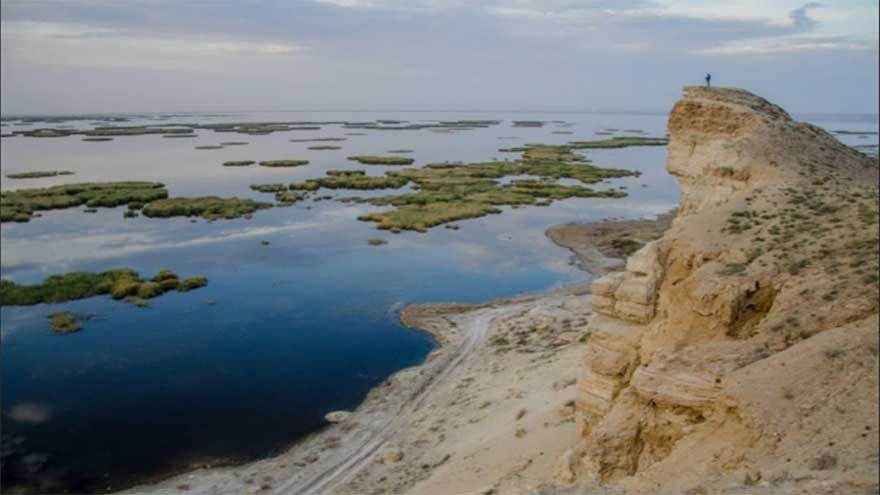
ISLAMABAD (APP) - A vast new desert ecosystem has formed on the dried seabed of the ‘Aral Sea,’ once the largest lake in Central Asia, dramatically reshaping the region’s environment and wildlife.
Known as the Aralkum Desert, the area emerged after decades of water loss that began in the second half of the 20th century. Today, it is considered one of the largest human-made deserts in the world, with more than 60,000 square kilometers of former wetlands transformed into arid land.
Scientists say the ecological shift has significantly altered the region’s climate, soil, and biodiversity. Species that once depended on wetland habitats have seen their ranges shrink sharply, according to researchers from the Institute of Zoology of the Academy of Sciences of the Republic of Uzbekistan, said a release issued here on Monday.
At the same time, the newly formed desert, located between the Ustyurt Plateau and the Kyzylkum Desert has given rise to a distinct bird community adapted to harsh, arid conditions.
To better understand this transformation, Uzbek scientists launched a research project in 2025 focused on the Aralkum’s birdlife, including species diversity, habitat distribution, and adaptation to environmental change.
Fieldwork carried out in October and November 2025 in the Muynak district divided the desert into 10-by-10 kilometer grid cells using geographic information systems.
Researchers surveyed 68 grid areas using walking transects and point-count observation methods to track bird populations across different landscapes.
The studies identified several types of habitats, or biotopes, within the Aralkum Desert. These include saline deserts dominated by salt-tolerant plants, sandy dunes with diverse vegetation, stony and gravelly areas formed from ancient islands, clay plains, and elevated coastal formations known as chinks.
In addition, remnants of the Aral Sea and a network of artificial water bodies created by drainage systems provide important habitats for water-dependent birds.
Researchers recorded 91 bird species across 12 orders and 26 families during autumn surveys. Among them are several rare and protected species, including the Cygnus olor, Phoenicopterus roseus, Aquila chrysaetos and Chlamydotis macqueenii.
Some of these species are listed in Uzbekistan’s Red Data Book as well as international conservation agreements, including the IUCN Red List and conventions on endangered and migratory species.
The findings show that bird diversity is highest in sandy desert areas near the Ustyurt Plateau, where vegetation is more varied and conditions are more favorable.
Hills and chinks also serve as important seasonal habitats, particularly during autumn.
By contrast, saline and clay deserts support fewer species, while highly specialized birds dominate stony and gravelly areas.
Researchers also found that the remaining natural water bodies of the Aral Sea are less important for waterfowl than expected. Instead, artificial reservoirs in southern areas have become key habitats for many water-dependent species.
Scientists say the rapid formation of the Aralkum Desert represents a rare case of a new ecosystem developing within a short historical period.
They add that the findings would help guide conservation efforts and identify critical habitats for bird species in the region.