
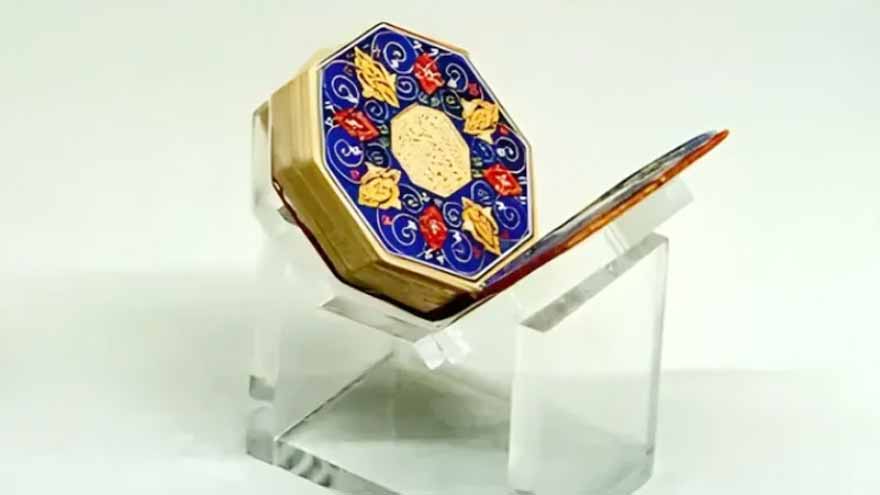
Summary The manuscript is notably small in size and falls into a category historically known as Hama’il.
(Web Desk) - A rare and remarkable copy of the Holy Qur’an, distinguished by its unique octagonal shape, has gone on display at the Museum of the Holy Qur’an, drawing significant attention from visitors and researchers alike.
Dating back to the 13th century Hijri (19th century CE), this extraordinary manuscript is believed to have been produced in the Indian subcontinent. Experts note that the octagonal design reflects a sophisticated blend of Islamic geometric art and functional craftsmanship, setting it apart from the more common rectangular Qur’anic manuscripts.
The manuscript is notably small in size and falls into a category historically known as “Hama’il” — portable Qur’ans designed for ease of travel. Such copies were often carried by individuals or even worn on the arm, offering both spiritual comfort and practical convenience during journeys.
This valuable artifact is part of the collection of the King Faisal Center for Research and Islamic Studies, an institution internationally recognized for preserving rare Islamic manuscripts using advanced scientific techniques.
The exhibition is also aligned with the broader mission of the Hira Cultural District, located near Jabal al-Noor. The center aims to establish Makkah as a global hub of Islamic culture by showcasing rare artifacts and utilizing modern technology to educate visitors about the historical evolution of Qur’anic writing.
Scholars highlight that such compact Qur’ans from India often feature Ghubar script, an extremely fine style of calligraphy requiring exceptional precision. Octagonal formats like this were particularly popular during the later Mughal period and were regarded as symbols of artistic refinement.