Summary Khamenei’s flag-draped coffin, and those of his family killed on Feb. 28 in an airstrike at the start of the war launched by Israel and the United States, will be carried on board a truck
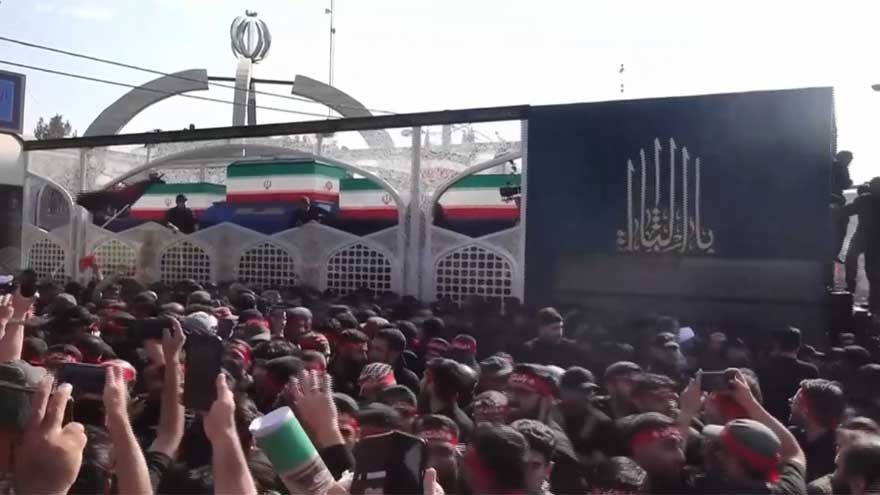
TEHRAN, Iran (AP) — Mourners dressed in black flooded into Iran’s capital on Monday for a procession as part of the funeral of the late Supreme Leader Ayatollah Ali Khamenei, with throngs of people calling for the death of US President Donald Trump.
Khamenei’s flag-draped coffin, and those of members of his family killed Feb. 28 in an airstrike at the start of the war launched by Israel and the United States, sat on board a truck decorated to resemble the ornamental grating that surrounds the shrine of an imam. The massive turnout came as Iran negotiates with the US over a permanent end to the war that killed the 86-year-old cleric.
Helicopter images aired on Iranian state television showed a massive crowd stretching from Tehran’s Azadi, or Freedom, Square for kilometers (miles) down a multilane street of the same name. The crowd appeared to be larger than the one that turned out for the 2020 procession for the late Revolutionary Guard Gen. Qassem Solemani, which drew over 1 million people.
Authorities offered no immediate crowd count as the truck crept down the street. But people alongside the truck and elsewhere on the route carried placards, signs and banners calling for Trump’s death.
“Today that we are here for the funeral for our leader, it’s a very tough day,” mourner Fatima Hassan said. “We are not here to say goodbye to him, we are here for revenge. And we will take revenge.”
Sea of mourners greets Khamenei
Mourners reached out to touch the truck, and some threw scarves and other items for attendants to brush against the coffin, a common practice in Iran seen as a blessing. Attendants, some on the ladders of firetrucks, sprayed misted water across the crowds to cool them in the heat.
Authorities appeared concerned about the dangers of having a large crowd alongside the procession, with officials on loudspeakers urging the public to walk slowly, not to push and to stay to the edges of the street.
The coffins will be taken through the streets of Tehran on a 12-hour journey to Mehrabad International Airport, said Revolutionary Guard Gen. Hasan Hasanzadeh, who is overseeing the procession.
Authorities have shut down streets, airspace and daily life for the mourning, which began on Saturday and will end on Thursday as Khamenei is buried at the Imam Reza shrine in Mashhad, his birthplace.
“This is the last time I am seeing him,” said a weeping Maryam Alizadeh. “Our generation lived with him for decades.”
Calls for Trump’s death grow as funeral goes on
As the funeral has gone on, however, there have increasingly been calls from mourners to avenge Khamenei’s death. Mourners and the signs they carry have called for the killing of both Trump and Israeli Prime Minister Benjamin Netanyahu. Such signs were seen again on Monday along the procession’s route, with one effigy of Trump being hanged.
“We are here to show that his path will continue, and every single one of these people will continue down his path with clenched fists and soon we will certainly avenge his death against the US and Israel,” said mourner Sahar Zaraatgar
US federal authorities have been tracking Iranian threats against Trump and other administration officials for years, stemming from Trump’s ordering the 2020 killing of Soleimani, who led the elite Quds Force. Iran has repeatedly denied plotting to kill Trump, though hard-line propaganda footage long has suggested Trump was in Tehran’s crosshairs.
Trump meanwhile promised to destroy Iran’s civilization during the war, among other threats.
Negotiations over war remain on hold
The US is meanwhile eager to press ahead with negotiations with Iran aimed at fully reopening the Strait of Hormuz, rolling back its disputed nuclear program and reaching a permanent end to the war. Talks appear to be on hold until after the burial.
The funeral was in part a show of unity as Iran demands a measure of control over the strait, a vital waterway for global energy that it shut down during the war. The US has rejected those demands, and the sides are divided on other key issues, including Iran’s nuclear program and the conflict between Israel and the Iran-backed militant group Hezbollah in Lebanon.
Iran’s new supreme leader, Ayatollah Mojtaba Khamenei, meanwhile has yet to make an appearance in the funeral ceremonies, which are unfolding over several days. He is believed to be in hiding after reportedly being wounded in the airstrike that killed his father.
At the height of the war before an April ceasefire, Israel targeted top leaders, in at least one case likely using their public appearance to fix their position. It has also threatened to kill the younger Khamenei.
Also read: Three sons of Iran's martyred leader Khamenei appear at funeral, not his successor
Three sons of late Iranian leader Ayatollah Ali Khamenei prayed beside his coffin and those of four other family members on Sunday, but Mojtaba, the son who has succeeded him as Iran's supreme leader, did not make an appearance.