
Summary With many countries racing to develop combat drones, Japan’s government prioritizes development of its own for a coastal defense, in combination with long-range missiles.
TOKYO (AP) — Japan needs to adapt to new methods of warfare like using artificial intelligence and drones that have been deployed in Ukraine and the Middle East and to strengthen its defense industry, the government said Tuesday.
Japan has bolstered its military capability and spending in recent years and has started deploying long-range cruise missiles as a deterrent to China’s military activity.
The 598-page defense paper adopted by the Cabinet on Tuesday reiterated that China is Japan’s biggest strategic challenge. Japan is alarmed by the growing presence and frequency of Chinese warships in the Pacific Ocean.
The annual white paper outlines Japan’s military activity and priorities and analysis of military trends in specific countries. As Prime Minister Sanae Takaichi’s government needs public support for further military buildup and spending and to attract service members, the report has features to appeal to readers including a cartoon on the cover and links to video clips in Japanese, English and Chinese.
Inspired by the use of drones by Ukraine, Japan considers it is essential to adapt to “new ways of warfare,” the paper said.
With many countries racing to develop combat drones, Japan’s government prioritizes development of its own for a coastal defense, in combination with long-range missiles.
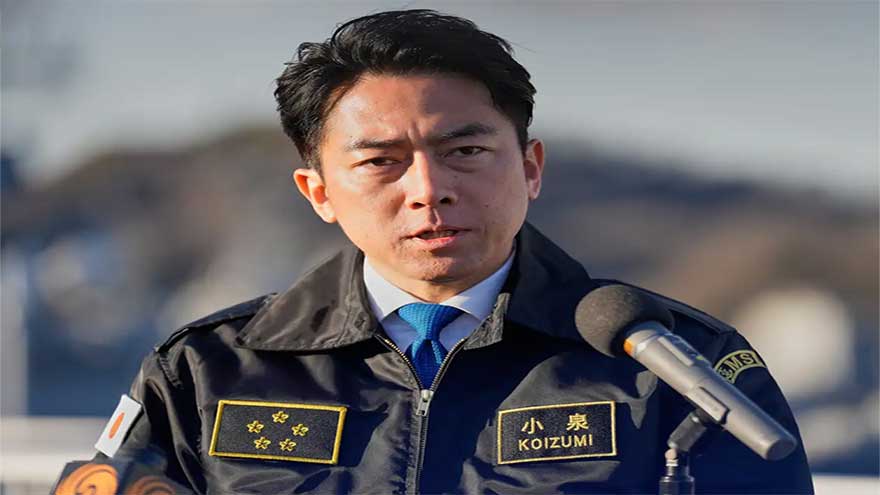
“Speed is key,” Defense Minister Shinjiro Koizumi said in early July.
A number of companies are developing similar drones. Toshiba announced Friday plans to jointly develop combat drones with startup Pro Drone.
Uncrewed weapons could help Japan make up for its decreasing number of service members in a country with a shrinking population.
Experts say developing fully homemade drones while Japan’s commercial drone market is dominated by Chinese imports would be a challenge.
Japan has strengthened its military forces on southwestern islands in recent years and has started deploying long-range cruise missiles, as it worries about a conflict in Taiwan, which China claims as its territory.
The paper noted the growing presence of Chinese warships and frequency of their activity in the Pacific as a major concern. The Defense Ministry has established a unit dedicated to studying Japan’s Pacific strategy and strengthening its defense against China.
China has consistently increased its military spending without transparency and strengthened nuclear and missile capability extensively and rapidly, the defense paper said.
It noted that last December, during Chinese aircraft carrier drills near southwestern Japan, Chinese aircraft locked their radars on Japanese planes — which is considered a possible preparation for firing missiles.
Two Chinese aircraft carriers were spotted last June near the southern Japanese island of Iwo Jima for the first time. This triggered Tokyo’s worries about Beijing’s rapidly expanding military activity far beyond its borders and in disputed areas in the East China Sea.
Tensions between Tokyo and Beijing have escalated since Takaichi said in November that Chinese military action against Taiwan could justify Japan’s use of force.
China on Tuesday rejected sections of Japan’s annual defense white paper concerning the Chinese military, calling the document “rife with false narratives” and accusing Japan of using it as “an excuse to ease restrictions on its military buildup.”
“It is a classic case of the thief crying ‘stop thief’ — a pretext to unshackle its own military,” said Chen Xi, a spokesperson for China’s Ministry of National Defense.
China’s growing joint military operation with Russia around Japan, including joint bomber flights and warship operations, is also “a grave national security concern,” the paper said.
It says North Korea’s rapid development of missiles, including hypersonic arsenals, is an “increasingly serious and pressing threat” and that the North’s growing military ties with Russia and its backing for Moscow’s war in Ukraine are a grave concern.
Strengthening arms production and technology is essential to Japan’s military power, the paper said. The government has been expanding funding for startups and scientific research.
In a country that had maintained a pacifist pledge since the end of World War II, many established companies avoid ties to lethal weapons, but a growing number of startups are showing interest in converting dual-use technology for military use, officials say.
Japan’s recent scrapping of lethal weapons export ban could also help strengthen the country’s underdeveloped defense industry.
Weapons technology transfer and joint development and production strengthens both the Japanese defense industry base and Japan’s ties with its defense partners, said Koizumi, whose travels to other countries have involved arms sales.
Japan recently made major deals, including the joint development and transfer of 11 upgraded Mogami-class frigates to Australia. It is discussing a similar deal with New Zealand and has struck a deal to sell retired destroyers to the Philippines.