Summary While China completed the bridge in 2014, hoping to boost trade ties, North Korea left its approach roads and customs facilities unfinished as relations soured over Pyongyang's nuclear tests
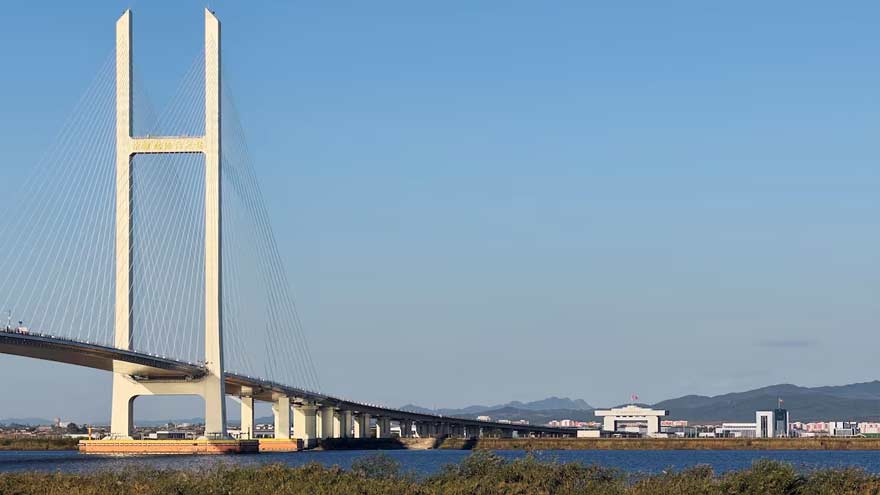
DANDONG, China, Oct 8 (Reuters) - Chinese taxi driver Wang peered through binoculars at a North Korean flag fluttering beyond a soon-to-open bridge linking his city of Dandong with the secretive nation.
"They finally finished their side," said the 40-year-old, one of dozens who gathered this week near the New Yalu River Bridge in the northeastern city, amid rumours that its opening will soon end a 12-year delay.
Coffee shops, a fun fair and a Little Yellow Duck theme park are springing up nearby, suggesting the struggling city hopes to cash in on the new link, but some residents and shopkeepers saw it more as a curiosity than an economic boon.
"It won't bring much new business here as regular citizens can't visit, but they're still our friends," Wang told Reuters during a visit on Tuesday, the 77th anniversary of the neighbours' diplomatic ties, referring to North Koreans.
While China completed the bridge in 2014, hoping to boost trade ties, North Korea left its approach roads and customs facilities unfinished as relations soured over Pyongyang's nuclear tests and the U.N. sanctions that followed.
Work resumed after a thaw in ties led to a June visit by Chinese President Xi Jinping, with both capitals having restored train services and direct flights, though neither has set a date to open the bridge.
The North Korean customs house appeared complete, while green signs were lit up over the gate on the Chinese side, though no traffic crossed.
The opening of the new bridge would show progress in ties, within weeks of North Korea opening its first road bridge with Russia.
FADED BORDER TOWN
The bridge delay was a setback for Dandong, whose economy thrived in the early 21st century as the primary trade gateway to North Korea's isolated economy.
For now, most goods still cross about 10 km (6 miles) upstream at an 83-year-old bridge with a rail track and a single-lane road. That remains the busiest of about 15 crossing points along the roughly 1,350-km (840-mile) border.
Recovering trade ties carried China's exports to North Korea to a six-year high of $2.3 billion last year, or an annual increase of 25%, though still well short of levels before the UN sanctions in 2017.
North Korea is accusing Washington of fueling tensions in the Taiwan Strait.
The uptick appears to have brought little benefit to Dandong, whose economy grew just 0.3% in the first half of the year against a national figure of 4.7%, with investment falling a third and new home sales down 28%, city data shows.
Although government offices in the city moved in 2011 to the Dandong New Zone near the new bridge, the area remains largely residential, with many apartments vacant.
Low pay was one reason why few workers stick around, said Wang, the taxi driver, adding that factory jobs in the locality pay only about 3,000 yuan ($420) a month.
'CUT OFF FROM THE WORLD'
There is also little optimism for an economic revival at a trade zone in Dandong called Guomenwan that is just a five-minute drive from the Chinese side of the new bridge.
Launched in 2015 with a reported investment of 1 billion yuan ($140 million), the complex now has mostly empty storefronts, with cafes, a vet clinic and a gym targeting the domestic market.
"This doesn't have much to do with us," a manager of the complex said, when asked about the bridge opening, speaking on condition of anonymity.
In its first few years, the zone imported large volumes of North Korean seafood and farm products, he said. But subsequent UN Security Council resolutions banned such imports, as well as sales of steel and industrial machinery to Pyongyang.
"Business is slow here," said Chen, a seller of curtains and fabric. "There aren't that many people doing up their homes."
Business was mostly local, added Chen, who gave only her surname, though she sometimes sees Chinese from ethnic Korean backgrounds working as middlemen, and the occasional North Korean buyer accompanied by an interpreter.
Yet tourists still throng steadily to Dandong to gaze across the river, gathering at the old bridge where merchants sell snacks and offer enticements such as games of ring toss.
But there the journey stops. North Korea has not reopened to Chinese tourists since sealing its borders in 2020.
"They've cut themselves off from the world," said Zhang, a passerby at the new bridge. "It would be better to do more business with South Korea."