Summary “We do not support the use of force or economic sanctions, and we hope that peace will prevail,” he added.
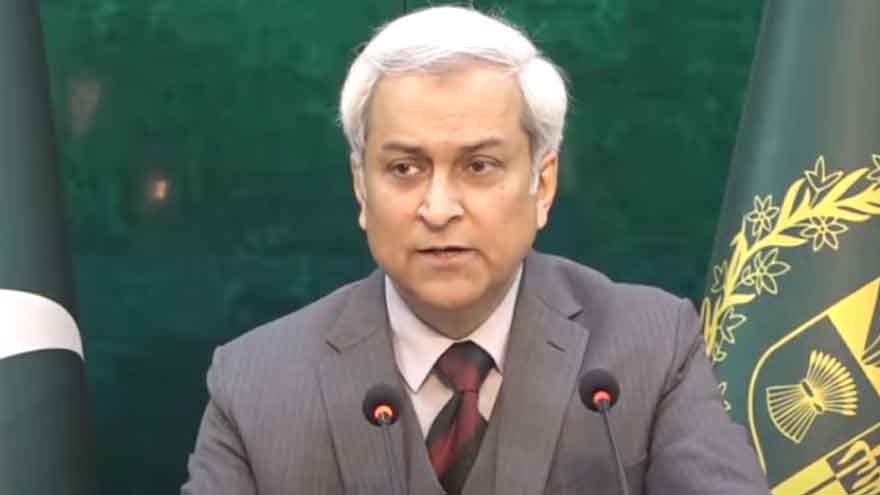
ISLAMABAD (Dunya News) – The Foreign Office (FO) spokesperson Tahir Hussain Andrabi on Thursday clarified that Pakistan would not become part of any Abraham Accords and had no connection whatsoever with the Abraham Accords.
During the weekly briefing, the FO spokesperson that Pakistan would not join the International Stabilization Force (ISF). He clarified that the Board of Peace and the Stabilization Force were entirely separate entities, and that Pakistan became part of the Board of Peace under mutually agreed governmental rules.
Commenting on concerns about the possibility of war involving Iran, the spokesperson said Pakistan has always advocated for the peaceful resolution of issues. “We do not support the use of force or economic sanctions, and we hope that peace will prevail,” he added.
Responding to a question regarding a trade agreement between India and Europe, Andrabi said Pakistan enjoys good relations with Europe, with bilateral trade exceeding 12 billion euros. He added that discussions have taken place regarding India’s agreements with European countries.
He further informed that President Asif Ali Zardari met UAE President Sheikh Mohammed bin Zayed Al Nahyan, during which Abu Dhabi’s Supreme Council for Financial and Economic Affairs emphasized exploring new investment opportunities in Pakistan and reviewing ongoing projects. Both countries agreed to take joint measures to enhance investment through flagship projects and expand trade relations.
Read more: PM says cabinet approved joining of Gaza Board of Peace
The briefing also highlighted that joint efforts are underway to resolve issues swiftly. This week, Deputy Prime Minister and Foreign Minister Ishaq Dar held telephone conversations with the foreign ministers of Iran and Bangladesh to discuss the regional situation. Additionally, delegation-level talks were held with Ghana on bilateral relations. President Zardari’s visit was described as a significant milestone for promoting investment, trade, economic cooperation, and people-to-people contacts.
According to the Foreign Office spokesperson, the Prime Minister also attended the World Economic Forum in Davos this week, where he met several global leaders. Deputy Prime Minister and Foreign Minister Ishaq Dar accompanied him during the visit. After returning from Davos, Ishaq Dar visited the United Arab Emirates, where discussions were held regarding investment in Pakistan by the telecommunications company Etisalat.
The spokesperson added that the Deputy Prime Minister and Foreign Minister Ishaq Dar spoke twice by phone this week with Iranian Foreign Minister Abbas Araghchi, discussing the situation in Iran and the wider region.
Regarding a travel advisory issued by the United States for its citizens traveling to Pakistan, the Foreign Office spokesperson said that relations between Pakistan and the US are good. He noted that the US has already withdrawn some previously issued travel advisories, and bilateral relations are proceeding normally.
He also announced that the President of Kazakhstan will visit Pakistan soon, with further details to be shared later. He said there has been no progress so far on the railway project between the two countries, but details of proposed memorandums of understanding will be announced in due course.