Summary European leaders have underlined that targeting civilian infrastructure in conflict is illegal, as tensions continue to rise across the Middle East and fears grow over a wider escalation.
BRUSSELS (Agencies) - The European Union on Monday warned warring parties in the Middle East that strikes on civilian infrastructure are illegal. This comes as the UN's atomic energy agency voiced concern over the heightened risk of a nuclear accident as hosilities intensify.
European leaders have underlined that targeting civilian infrastructure in conflict is illegal, as tensions continue to rise across the Middle East and fears grow over a wider escalation.
Speaking on Monday, EU Council president Antonio Costa said any strikes on civilian facilities – particularly energy infrastructure – were "illegal and unacceptable". His comments came after US President Donald Trump threatened to devastate Iranian infrastructure if Tehran failed to reopen the strategically vital Strait of Hormuz.
Costa stressed that the principle applied universally, drawing parallels with Russia’s war in Ukraine. He warned that ordinary Iranians would bear the brunt of any escalation, describing them as “the main victim” of both their government and any widening military campaign.
The European Union also called on Iran to halt attacks in the region and restore full freedom of navigation through the strait, a crucial artery for global energy supplies.
After five weeks of conflict, Costa struck a cautiously hopeful note, arguing that "only a diplomatic solution" could address the root causes of the crisis.
ESCALATION ON MULTIPLE FRONTS
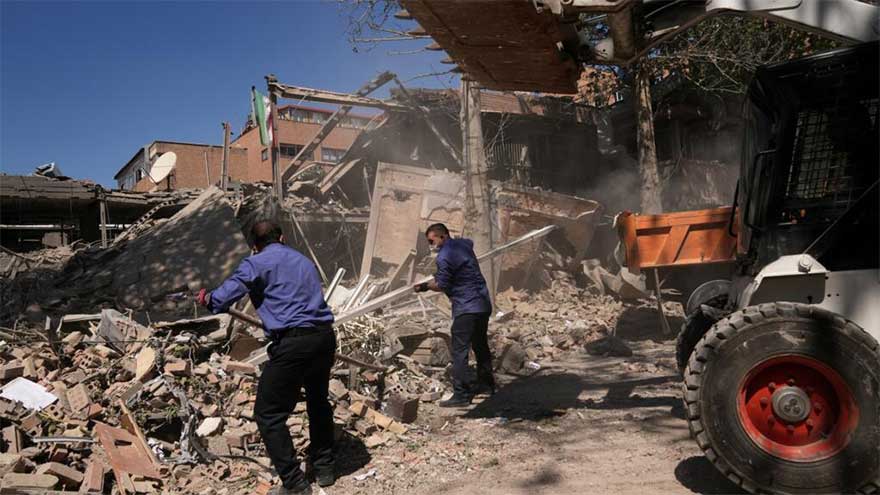
Meanwhile, in northern Israel, the military confirmed that four people killed in a missile strike in Haifa were members of the same family. Rescue teams worked for 18 hours to recover the bodies from deep beneath the rubble, with officials noting that an unexploded warhead had complicated efforts and posed ongoing danger.
Israel also said it had killed Asghar Bakeri, a senior figure in Iran’s Revolutionary Guard linked to its overseas Quds Force operations. According to military officials, he had been involved in planning attacks against Israeli and US targets across the region.
Alarm over the conflict has also been heightened by warnings from the International Atomic Energy Agency, which said strikes near Iran’s Bushehr nuclear power plant pose a serious risk.
IAEA chief Rafael Grossi cautioned that attacks close to the facility could trigger a "severe radiological accident" with consequences far beyond Iran’s borders. One strike reportedly landed just 75 metres from the plant’s perimeter, underlining how narrow the margin for error has become.
While the agency confirmed the plant itself had not been damaged as of Sunday, the proximity of repeated strikes has raised concern. Iran’s Atomic Energy Organization says four incidents have occurred near the site since fighting began on 28 February, with the most recent killing a security guard and damaging a support building.
In neighbouring Lebanon, an Israeli strike on an apartment building in Ain Saadeh killed an anti-Hezbollah politician, his wife and another woman. Israel said it had been targeting a militant but acknowledged reports that civilians were harmed and said it was investigating.
This comes as Israel has also turned on Iran’s critical energy infrastructure, having carried out a "powerful strike" on the South Pars petrochemical facility in Asaluyeh – a site responsible for around 50 percent of Iran’s petrochemical production.
Iranian media reported attacks on the wider South Pars gas field, blaming both Israel and the United States, though neither country immediately confirmed involvement.
Against this backdrop, Trump has reiterated threats of further action against Iran, including potential strikes on power plants and bridges if shipping through the Strait of Hormuz is not restored.
'BALL OF FIRE'
A former director of the United Nations nuclear watchdog urged Gulf nations on Saturday to prevent Trump from turning the region into "a ball of fire".
"To the Gulf governments: Please, once again, do everything in your power before this madman turns the region into a ball of fire," Mohamed El-Baradei, who led the International Atomic Energy Agency (IAEA) from 1997 to 2009, wrote on social media platform X.
In a separate post also referencing Trump's ultimatum to Iran that it will face "all hell" unless it strikes a deal, El-Baradei tagged UN and European Union accounts, as well as French President Emmanuel Macron.
"Nothing can be done to stop this madness?!" he wrote, also tagging the Chinese and Russian foreign ministries.