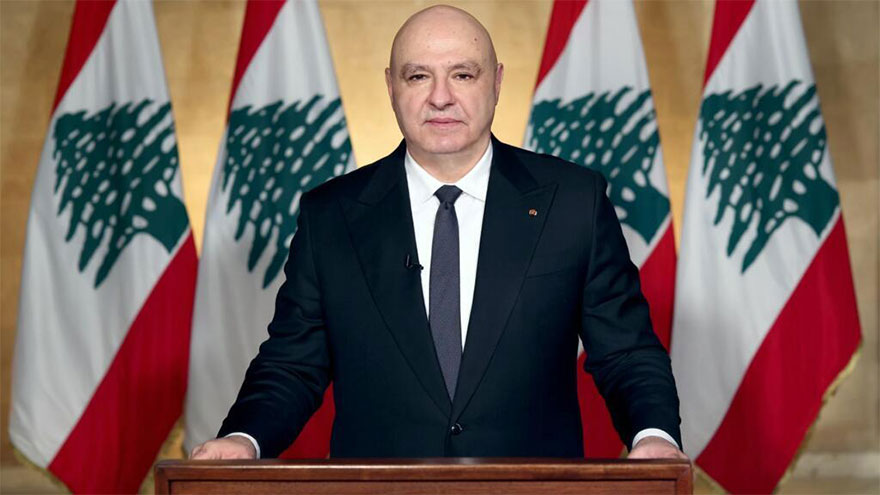
Summary Lebanese President Joseph Aoun said Monday that planned talks with Israel aim to end hostilities and the occupation in the south.
BEIRUT (Lebanon) (AFP) – Lebanese President Joseph Aoun said Monday that planned talks with Israel aim to end hostilities and the occupation in the south, even as Hezbollah and its supporters rejected the negotiations.
Hezbollah lawmaker Hassan Fadlallah told AFP it was in Aoun's and Lebanon's "interest" to withdraw from the talks, however adding that his group also wanted a ceasefire to last.
US President Donald Trump on Friday announced a 10-day truce pausing more than six weeks of war between Hezbollah and Israel.
But Lebanon's official National News Agency (NNA) reported an Israeli drone strike in Qaqaiyat al-Jisr in the country's south on Monday, and Israel artillery shelling on the frontier town of Hula.
The Lebanese health ministry said six people were wounded in Qaqaiyat al-Jisr.
Israel's army said in a statement that soldiers "identified terrorists" in the Bint Jbeil and Litani areas of south Lebanon "who violated the ceasefire understandings", adding that that the air force "eliminated" them.
The NNA also reported Israeli army "detonations... in parallel with extensive demolition" operations in Mais al-Jabal, decrying "the systematic destruction impacting homes and livelihoods, buildings and infrastructure" in the town and several other border villages.
Fadlallah told AFP that "it is in the interest of Lebanon, the president of the republic and the government to move away from the path of direct negotiation and return to a national understanding about the best option for Lebanon".
'THREAT'
"Perhaps through indirect negotiations, even via the United States of America, we can achieve" Lebanon's goals, Fadlallah said.
Aoun said the aim of negotiations was to "stop hostilities, end the Israeli occupation of southern regions and deploy the (Lebanese) army all the way to the internationally recognised southern borders".
Fadlallah said regional powers including Iran, Pakistan and Saudi Arabia have worked to build a US-Iran diplomatic track, creating "a regional umbrella that can provide a kind of guarantee for Lebanon.
"Going into direct bilateral negotiations, alone, amid deep Lebanese divisions and internal disagreements, constitutes a threat to internal consensus."
Aoun on Friday had said that "we negotiate for ourselves... we are no longer a pawn in anyone's game, nor an arena for anyone's wars, and we never will be again."
Tehran had insisted that a Lebanon truce was among its conditions for a ceasefire with Washington in the Middle East war.
On the road to Beirut airport, in the southern suburbs where Hezbollah holds sway, AFP images showed fresh graffiti attacking Aoun and Prime Minister Nawaf Salam following their endorsement of negotiations.
"Joseph is a traitor, Nawaf is a turncoat," said one spray-painted sign.
"Dealing with Israel is forbidden... no to normalisation," another read.
'SACRIFICES'
Hezbollah supporters also heaped scorn on Aoun on social media.
"You're going to hand over the south after two days of negotiations?" one user posted on X, adding "we won't let you" sign an agreement.
"After all our sacrifices this guy wants to speak for us?" another user posted on X, with their profile picture showing a photo of Aoun and Salam with the words "they do not represent me".
Israeli attacks killed more than 2,300 people in Lebanon and displaced more than one million.
"Any outcome of direct negotiations cannot be imposed on the people who made these sacrifices," Fadlallah told AFP.
Aoun on Monday named former Lebanese ambassador to Washington Simon Karam to head the negotiations with Israel.
Lebanon has no diplomatic relations with its southern neighbour.
In December, Karam became the first Lebanese civilian representative to directly speak with Israeli representatives in decades, as part of a committee to monitor a 2024 ceasefire between Israel and Hezbollah.
Aoun said Monday that Lebanon faced two options: ongoing conflict "or negotiations to put an end to this war and achieve lasting stability".
"I have chosen negotiations, and I am full of hope that we will be able to save Lebanon," he said.