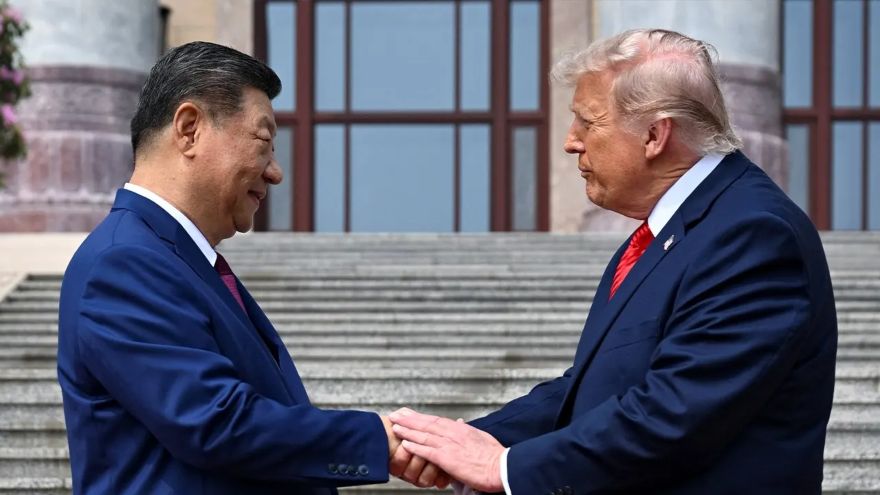
Summary The first visit by a US president since 2017 to the United States' main strategic rival has several high-stakes issues on the agenda
BEIJING (Agencies) – US President Donald Trump and Chinese President Xi Jinping today exchanged unusually warm remarks alongside stark warnings over geopolitical tensions during a high-profile summit in Beijing, where both leaders signalled openness to cooperation while acknowledging deep divisions over Taiwan, trade and global security.
Trump hailed “extremely positive” discussions with Xi during a lavish state banquet at the Great Hall of the People, attended by senior Chinese officials and American business leaders including Elon Musk, Apple CEO Tim Cook and Nvidia chief Jensen Huang. Calling Xi a “friend” and a “great leader”, Trump said he believed the relationship between the United States and China “is going to be better than ever before” and suggested their countries would have “a fantastic future together”.
.@POTUS delivers remarks at the state banquet dinner at the Great Hall of the People: "It was a fantastic day, and in particular, I want to thank President Xi, my friend, for this magnificent welcome... and for so graciously hosting us on this very historic state visit." pic.twitter.com/lcFTC7wUY9
— Rapid Response 47 (@RapidResponse47) May 14, 2026
The US president also described the summit as potentially “the biggest ever” and said he had invited Xi and his wife Peng Liyuan to visit the White House on September 24. The visit marks the first by a US president to China in nearly a decade, with the high-profile reception contrasting with unresolved tensions over trade imbalances, technology restrictions and regional security disputes.
.@POTUS extends an invite to President Xi and Madame Peng to visit the White House this September, proposes a toast at the state banquet dinner in Beijing:
— Rapid Response 47 (@RapidResponse47) May 14, 2026
"To the rich and enduring ties between the American and Chinese people. It's a very special relationship." pic.twitter.com/HdrRIJ6KMX
Xi, speaking at the banquet and earlier in closed-door meetings, struck a more cautious tone while emphasising the importance of stability in bilateral relations. He said China and the United States should “be partners and not rivals”, adding that cooperation would benefit both sides while confrontation would be harmful. Xi also referenced the idea of the “Thucydides Trap”, questioning whether the two powers could avoid conflict as strategic rivals and instead build what he called a “new paradigm for major-power relations”.
A key focus of Xi’s warning was Taiwan, which he described as the most sensitive issue in China-US relations. According to China’s foreign ministry, Xi told Trump that mishandling the issue could push the two countries towards confrontation and even conflict. He stressed that the Taiwan question could place the broader relationship in a “highly perilous situation”.
President Xi offers a toast at the state banquet dinner in Beijing: "To the bright future of China-U.S. relations, and the friendship between the two peoples, and to the health of President Trump and all of the friends present." pic.twitter.com/VmJeU4Xk1f
— Rapid Response 47 (@RapidResponse47) May 14, 2026
The comments were echoed in a broader Chinese position that Taiwan remains a potential flashpoint, with Beijing reiterating its claim over the self-governed island. The United States maintains official ties only with Beijing but is legally bound to provide Taiwan with defensive support, a policy that has long been a source of friction between the two powers.
Trump, who arrived in Beijing earlier in the week, did not publicly address Taiwan during his initial remarks at the summit but previously indicated he intended to discuss US arms sales to the island. His administration has in recent months approved major defence packages for Taiwan, although delivery timelines remain uncertain.
Despite the tensions, both sides signalled progress on economic matters. Xi told US executives accompanying Trump that China’s markets would “open wider” in the future and that American companies would enjoy “brighter prospects” in the country. He also said recent preparatory economic talks between US and Chinese teams in South Korea had produced “balanced and positive outcomes”, aimed at maintaining a fragile trade truce established in earlier negotiations.
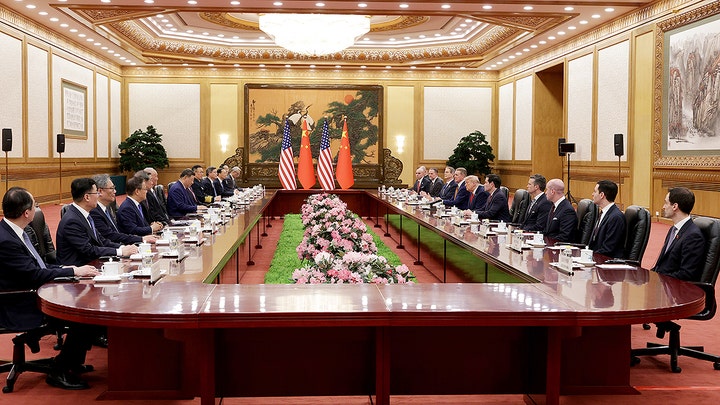
Trade and tariffs remained central to the agenda, with discussions expected to include agriculture, aircraft purchases and rare earth supply chains. Agriculture in particular has emerged as a key area of potential agreement, with China renewing export licences for hundreds of US beef processing facilities after previous approvals lapsed, affecting more than 400 plants in the past year.
Officials and analysts described the renewals as a sign of goodwill amid ongoing negotiations, with Beijing signalling limited but notable easing in specific trade sectors. However, broader structural issues including tariffs, technology competition and export controls remain unresolved.
The summit also touched on global energy and security issues, including discussions around the Strait of Hormuz and China’s role as a major buyer of Iranian oil. Washington has sought greater Chinese engagement in stabilising regional tensions linked to the ongoing conflict involving Iran, while Beijing has maintained its economic ties with Tehran despite Western sanctions.
In parallel with the high-level talks, Xi hosted a separate meeting with leading US business figures including Musk, Cook and Huang, where he reiterated that China would continue to expand access for foreign companies. Musk later described the meeting as “wonderful”, while Huang said both leaders had been “incredible”.
The summit programme included ceremonial displays at the Great Hall of the People, featuring military honours, a gun salute and a welcome ceremony with schoolchildren waving flags and chanting greetings. Trump, visibly engaged during the reception, described the atmosphere as a sign of a strengthening relationship.
Further talks between Trump and Xi are scheduled to continue, alongside a tea reception and additional diplomatic meetings before the US president departs for Washington following the conclusion of the two-day summit.